
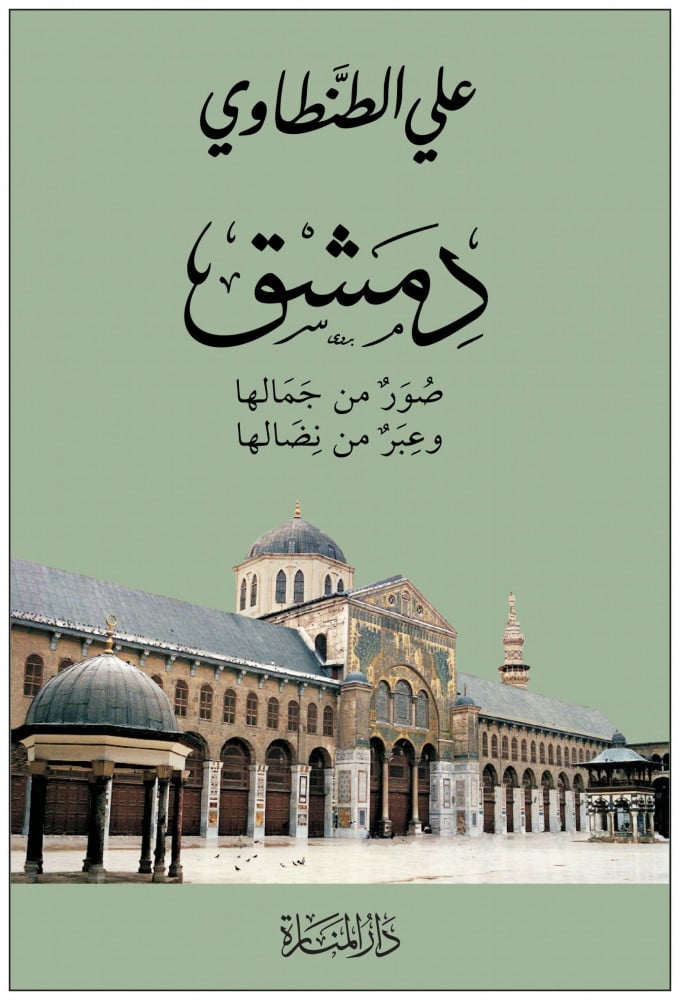
Damascus Book by Sheikh Ali Al-Tantawi
This book includes nineteen articles written between 1931 and 1964. Old editions of it were issued in 160 pages of regular cut (17×24), and then reissued recently by the author’s grandson, Mujahid Mamoun Diraniyeh, in 300 pages of medium cut (14×21). ) after adding to it an appendix containing about a hundred pages of photographs, which are arranged in three chapters: “Men from Damascus”, “From the History of Damascus”, and “From the Landmarks of Damascus”, in addition to some useful maps.
The full name of this book is: “Damascus: Pictures of Its Beauty, and Lessons from its Struggle.” This title suggests that the book’s articles are descriptive or historical. The truth is that there is a lot of that in it, but the book also contains images of literature and an abundance of feelings and feelings that are closer to “talk to the soul.” Rather, it contains chapters of memories, such as the article “A Waterwheel in Damascus” (and it contains fragments of memories of study in the book) and "Maktab Anbar", and the latter was originally a preface written by the author to a book published by Dhafer Al Qasimi on Maktab Anbar in 1963. Maktab Anbar is the name of the secondary school in which Ali al-Tantawi studied, which had a great impact on his life, and therefore it was not surprising that writing this book provoked Introduction His feelings and to awaken his memories, so we find that he has gone - in it - in these memories while he says, addressing the author of the book: “You moved my soul, sent me memories of my evening, and shook me, until I felt as if my past days had returned to me. Will the past days return? It was the era of the office of the dormitory of my paradise, from which I left and then did not return to it, so you returned me to it - my brother Zafer - with your book.
In some articles there are historical literary pictures that we almost feel, as we read them, that we are living in Damascus in some of its old days. Such as the article "Eid in Damascus", which describes the feast in the homes and neighborhoods of Damascus at the beginning of this century, and "Damascus, which I knew when I was young." In many of the book's articles, there is a literary depiction of a historical reality. Such as the article "The Disaster of Damascus", and from this section are articles that talk about stages of jihad and struggle that preceded the independence of the Levant and the evacuation of the French from it, including: "Children of Damascus" and "Introduction to a Book on Damascus", which concludes with the articles "Tears and Tears" and "The Evacuation from Damascus". which were published after the evacuation in 1945.
In my articles "Hay al-Salihiya" and "The Originator of the Muhajireen Quarter in Damascus," we read parts of the city's history. In the first, a detailed history of this neighborhood from the neighborhoods of Damascus, from the day it was settled by the Qudamah family (the famous family of Hanbali jurists, including al-Muwaffaq, the author of al-Mughni; the most extensive book of the doctrine) when they sought refuge in Damascus to escape from the Crusaders in Palestine, and in the second a detailed history of the “Muhajireen” neighborhood, which was not Something at the beginning of the last Hijri century, then it became one of the best neighborhoods in Damascus at the end of it. In the article - also - a brief review of the work of a number of late Ottoman governors in Damascus.
As for the rest of the book's articles, they are almost limited to describing Damascus, as if it was the one for which the book deserved - for its sake - to have "images of its beauty" added to its name, just as it deserved - for the sake of the previous articles - to have "lessons from its struggle" added to it. Among these articles is the article "This is Damascus", in which the reader feels - along with him - that he visited it and moved in its streets and between its neighborhoods and toured its most important landmarks, including the article "Damascus River" in which the author describes "Barada", and the article "Fifth Avenue in Damascus". And the article “On the Slopes of Jabal Al-Sheikh,” which is one of the last articles written in the book. It was published in 1964.