
Arabic series in your hands
Student's Book All Levels
Introduction to the Arabic series in your hands:
The Arabic for All series is a project of the Arabic for All program. This series includes an update to the book "Arabic for All," which contains a comprehensive curriculum for teaching Arabic to non-native speakers. The curriculum was developed for educational institutions, including schools, institutes, and universities, starting with the student from the beginning and continuing with them until they master Arabic to the point where they can enroll in university and continue their studies in Arabic in any major they choose. It was developed by the original authors, a team of academics specializing in teaching Arabic to non-native speakers. Here is a brief introduction to the new edition of the series and its books:
The new edition of the series consists of the following books and materials:
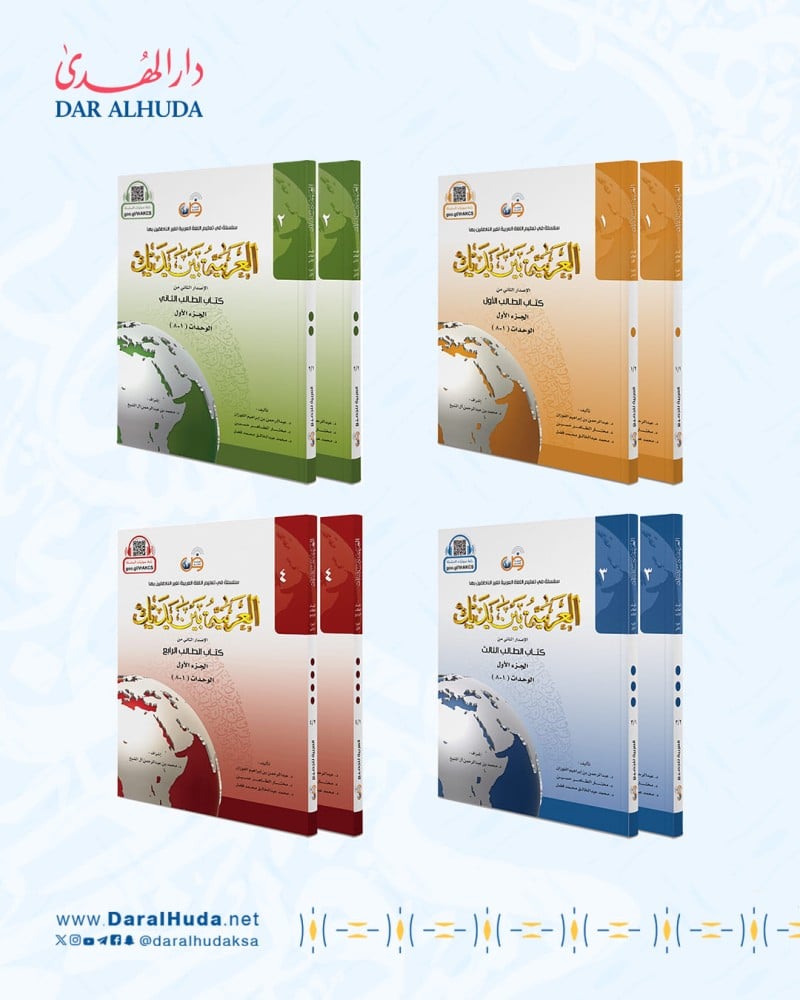
Educational books, divided into four educational levels, including 8 books:
1. Beginner level, which includes: The first student’s book in its two parts.
2. Intermediate level, which includes: The second student’s book in its two parts.
3. Advanced level, which includes: The third student’s book in its two parts.
4. The distinguished level includes: the fourth student’s book in both parts.
Audio materials accompany each of the eight student books.
Series audience:
The series is intended for adult learners.
Series language:
The series is based on classical Arabic, without resorting to any intermediate language.
The total number of lessons for the four student levels in their eight books (576 basic lessons) is distributed as follows:
First student level with its two books (Part One + Part Two): 144 basic lessons, in 16 units.
Second-year student level with both books (Part One + Part Two): 208 basic lessons, in 16 units.
Third-grade student level with its two books (Part One + Part Two): 112 basic lessons, in 16 units.
Fourth-grade student level with its two books (Part One + Part Two): 112 basic lessons, in 16 units.
Total basic lessons = 576 lessons + 24 lessons for tests = 600 lessons.
The total vocabulary of the series at its levels (3325 words) is distributed as follows:
1. Level 1 741 words.
2. Level 2 946 words.
3. Level 3 853 words.
4. Level 4 785 words.
Series objectives:
The series aims to achieve the following competencies:
1 - Linguistic competence: It includes language skills and their elements as follows:
A_ The four language skills, which are:
1- Listening (listening comprehension).
2- Speech (talk).
3- Reading (reading comprehension).
4- Writing (automatic and creative).
B_ The three linguistic elements, which are:
1- Sounds (and various acoustic phenomena).
2- Vocabulary (contextual and idiomatic expressions).
3- Grammatical structures (with an appropriate amount of grammar, morphology and spelling rules).
2- Communicative competence.
3- Cultural competence.
Time allocated for teaching the series:
The total expected time for teaching the series is 600 study hours, which can be distributed according to each program and the number of hours it allows for teaching Arabic per week, including:
24 weeks, in a program that allows her 25 hours per week.
30 weeks, in a program that allows her 20 hours per week.
40 weeks, in a program that allows her 15 hours per week.
60 weeks, in a program that allows her 10 hours per week.
75 weeks, in a program that allows her 8 hours per week.
120 weeks, in a program that allows her 5 hours per week.
Features and advantages of the “Arabic in Your Hands” series:
1- The original authors developed it to become one of the most modern series for teaching Arabic to non-native speakers, utilizing the latest methods and techniques in foreign language teaching.
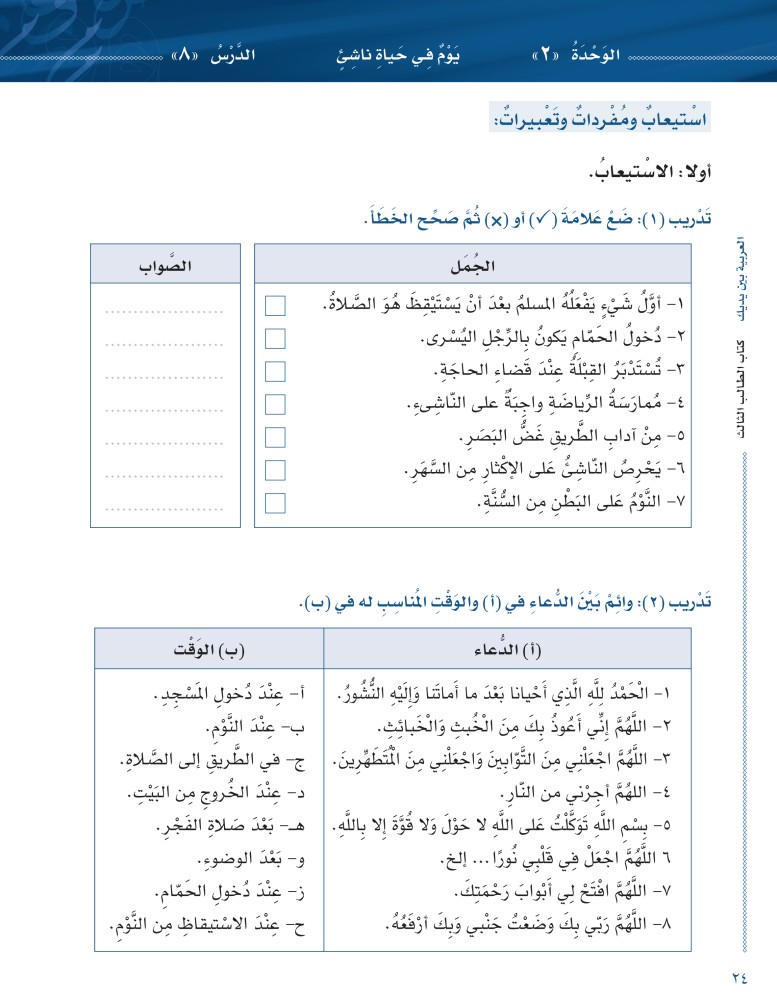
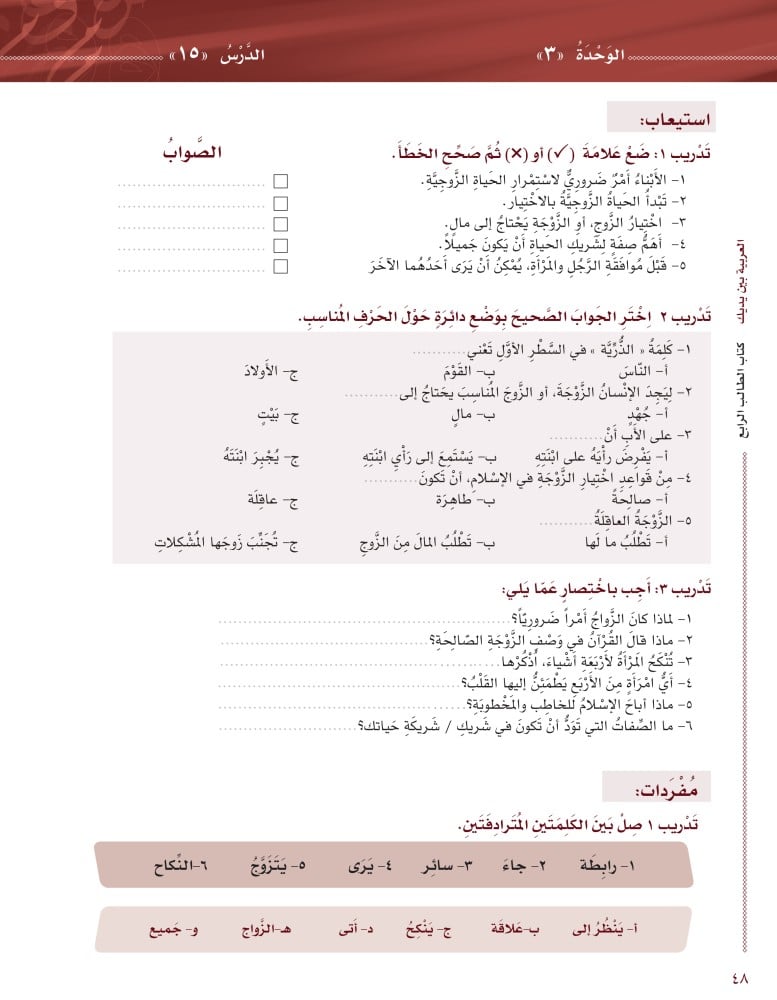
2- The exercise and activity books were included in the student books for practical reasons.
3- Integration between the three language competencies: linguistic, communicative and cultural.
4- Observe the gradual presentation of the scientific material and follow the educational unit system in presenting the material, with complete control over the number of vocabulary and structures in each unit.
5- The structural geometric regularity of the units, and the structure of each book took a different form to suit the educational level.
6- The sounds and acoustic phenomena were processed in new and different ways, in addition to the complete morphological control of the texts.
7- It included many different types of standard and achievement tests, at the beginning, middle, and end of each book.
8- The series focuses on the teacher, creating a separate teacher's book for each level. It contains answers, as well as guidelines for classroom management, foreign language teaching methods, skills and elements presentation techniques, how to conduct exercises, design tests, and more. Hence, the teacher's book is unique in its field.
9- Praise be to God, the series has been adopted so far in more than 1,200 universities, institutes, and schools around the world.